
In this article, I enumerate the costs of setting up and running a node in Nigeria, informed by my experience of running one over the past couple of years. I also offer some cost mitigating suggestions to hopefully encourage more participation on the bitcoin network.
Before exploring the costs involved: What is a bitcoin node?
A bitcoin node is software that connects to the Bitcoin peer-peer network. A node receives, validates and broadcasts transactions/blocks to other nodes on the network, according to the network rules. Ted Stevenot concisely described nodes as the messengers and rule keepers of Bitcoin.
The broadcast blocks are part of a distributed ledger which contains records of each transaction, keeps track of bitcoin ownership and the corresponding amount owned. This publicly shared ledger is generally known as the Bitcoin blockchain.
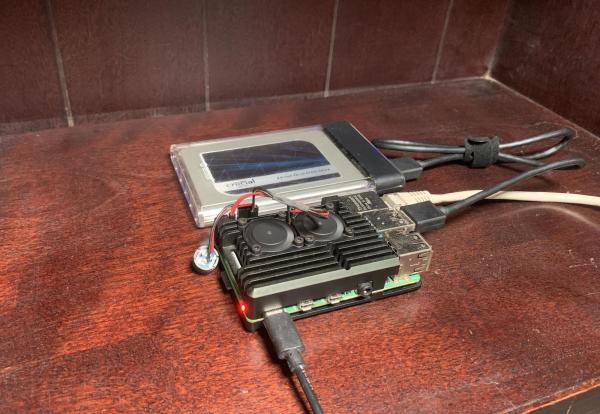
A Bitcoin node is usually run on portable single-board computers (SBCs) like the Raspberry Pi, or on a personal computer. However, a node can also be run in a virtual machine or on a smartphone. Bitcoin Core is the most widely used bitcoin node software and can be downloaded here.
Nodes can either be full or light:
- A full node stores a full copy of the blockchain and verifies every transaction and block, from the first block — the genesis block — against the consensus rules. Consensus rules are specific rulesets enforced by full nodes to determine the validity of a block and its transactions.
There are two types of full nodes: archival nodes and pruned nodes. Archival nodes store the entire blockchain locally and relay it to other nodes, this also helps to bootstrap new ones. Meanwhile, a pruned node only saves a specified minimum number of blocks as it verifies transactions and blocks. Therefore, more computer disk is saved by pruned nodes compared to archival nodes. However, pruned nodes are unable to serve the entire blockchain to other nodes.
- A light node does not enforce the consensus rules and relies on third party run full nodes to receive block data, which involves a privacy trade-off.
Full nodes will be the main focus of this article — any mention of “node” hereafter implies a full node unless explicitly stated.
Why Run A Node?
There are personal and network benefits to running a node. Some of these include:
- Privacy when broadcasting transactions, verifying bitcoin received in your wallet, and exploring blockchain data, without third parties logging your personal information.
- Enforcing the consensus rules which helps uphold bitcoin’s integrity and your investment in it. Furthermore, running a node enables you to either reject or support any proposed changes — soft or hard forks — to the consensus rules. Reciting Raspiblitz’s slogan: Not your node, not your rules .
- Strengthening the Bitcoin network. The more nodes on the network, the more decentralized and resilient Bitcoin is against malicious parties, jurisdictional restrictions or black swan events.
- Increasing your understanding of how the bitcoin network operates and sharing this acquired knowledge with others.
With some of the benefits outlined, let’s analyze the costs of running a node from a Nigerian perspective.
Hardware
The common hardware, that meet the minimum requirements, used to run a bitcoin node on are either:
- Plug and Play nodes or
- Do-It-Yourself (DIY) nodes.
Plug And Play Node
Some bitcoin companies offer plug and play full node products that run on SBCs like the Raspberry Pi, RockPro64 and Rock Pi4, and mini PCs like the Intel NUC and Librem Mini. Some of these node providers are:
- MyNode
- Raspiblitz
- RoninDojo and
- Start9
Node prices range from $300 to $700 — excluding shipping ($100 minimum to Nigeria) and customs duty — dependent on hardware and storage size. Currently, international purchases made on most Nigerian Naira debit cards are limited to $20 per month, a reduction from a previous $100 limit. Your node purchase options are to use a dollar debit card — tied to a domiciliary account — with deposited dollars obtained from the black market (currently 70% above the official rate), use a virtual dollar card which offers convenience but at a higher rate than the black market, and bitcoin.
There are other obstacles you might encounter in purchasing a node. Firstly, not all node providers ship to Nigeria. Additionally, due to chip shortages, some of these products are out of stock. One way of surmounting some of these hurdles is employing the alternative availed by node providers of sourcing node components yourself, and installing their respective bitcoin core embedded software on your assembled node.
DIY Node
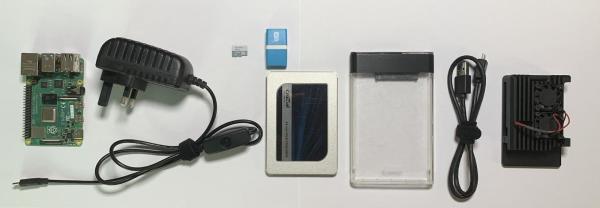
In sourcing hardware components, we’ll only consider SBCs as they are cheaper than mini-PCs. The hardware components required to run an SBC node are:
- SBC + power supply
- SD card + reader
- SSD + enclosure
- Heatsink case/fan
The current chip shortages and high demand for single board computers have led to a massive increase in prices and supply deficits, Raspberry Pis in particular both locally (used and new) and internationally. However, some Raspberry Pis and RockPro64s are available on Aliexpress. Regardless, there are some fake sellers on the platform, you need to be especially wary of newly created stores, read negative reviews and request a refund if an item does not arrive within the estimated period.
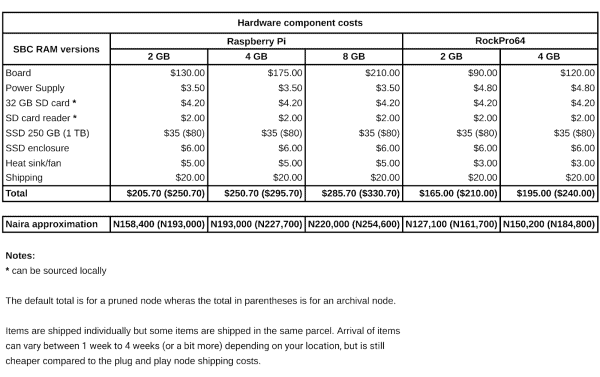
Considering the international purchase limit on Naira debit cards, these SBCs will need to be purchased using a dollar card — there is no bitcoin purchase option. The table below summarizes average hardware component costs from Aliexpress, for building new Raspberry Pi or RockPro64 nodes.
Data
Before a node is able to perform its role as a messenger and rule keeper on the bitcoin network, it needs to be synchronized with other nodes on the network. This is done by downloading and verifying all the blocks from the genesis block in a process known as the Initial block download (IBD). Currently, the bitcoin blockchain is approximately 440 GB in size.
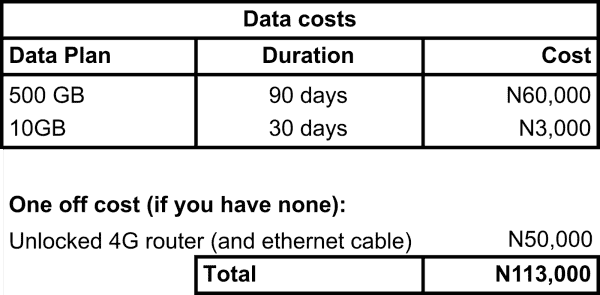
The following table summarizes the average data costs, from network providers, for the IBD and roughly 5.3 GB required monthly to sync your node with the blockchain. An assumption is made that you reside in an area with somewhat reliable 4G network coverage.
Power
To simplify the power cost analysis, the assumption is made that you live in a region with no electricity (at least 80% of the time in my location) and will need a solar generator to power the node and router, which isn’t ideal as it’s weather dependent. Replicating something similar to Chimezie Chuta’s Spacebox incurs the subsequent mean costs.
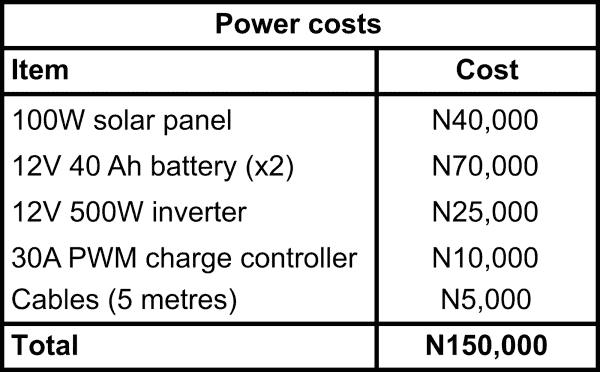
Finally, the estimated full node setup costs is tabulated below.
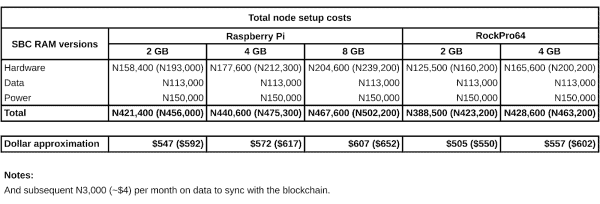
In Conclusion
Running your own Bitcoin node has a lot of benefits, some of which were listed earlier on. However, with ongoing chip shortages, inflation and node setup costs (despite the assumptions and cost-cutting recommendations made herein), running a node might not be feasible for everyone. One practical solution would be to implement Arman The Parman’s circle of trust idea or Obi Nwosu’s guardians and users model of having a technical individual run a node for a trusted group of people like close friends, a family or community. This approach does involve a trade off, but is much better than connecting to third party nodes and helps in easing bitcoin’s custody challenge.
This is a guest post by Chinedu. Opinions expressed are entirely their own and do not necessarily reflect those of BTC Inc or Bitcoin Magazine.